Tuesday, January 30, 2007

What do you think the Internet use by SA's daily newspapers shows?

After the Bivings Report released an analysis of the Top 100 newspapers in America and their use of the web last August, I volunteered to take a look at how their South African counterparts were doing.

The SA study kept moving down and along my ‘To Do’ list until, in a last-gasp attempt to clear my list (and my conscience) before I logged off for the Christmas break, I solicited the help of Jethro Goko, a South African editor participating in our Journalism Leaders Programme . Jethro, who edits The Herald in Port Elizabeth, asked a staffer, Duncan Reyneke, to help collect the data. Today, I finally got around to writing some of it up and will keep posting bits as time allows and in response to questions.

The chart here shows the preliminary results of our analysis of the websites of the 19 daily newspaper titles in SA, as monitored by South African Advertising Research Foundation (Amps 2006A). Whatever else it shows – and I’d certainly welcome your insights – it’s clear that South African newspaper websites have a way to go.

While the country's largest circulation (tabloid) daily doesn't have a website at all, there is evidence of some experimentation with multimedia amongst the traditional titles. Notably, Media 24’s Die Burger, introduced audio and video last year.

However, in the main, South African dailies seem to be ignoring the key opportunity the Internet offers – the ability to engage in dialogue and collaborate with users. Or, to paraphrase Dan Gilmore, most still see news as a lecture, not as a conversation. That implies listening at least as much as you speak.

The papers, listed in order of readership and market share, are:

Daily Sun 12.4 none
Sowetan 4.9 http://www.sowetan.co.za/
Isolezwe 2.3 http://www.isolezwe.co.za/
The Star 2.2 http://www.thestar.co.za/
Die Burger 1.6 http://www.dieburger.com/
The Citizen 1.5 http://www.citizen.co.za/
Beeld 1.4 www.news24.com/Beeld/Home/
Daily News 1.1 http://www.dailynews.co.za/
Cape Argus 1.1 http://www.capeargus.co.za/
Daily Dispatch 0.8 http://www.dispatch.co.za/
Cape Times 0.8 http://www.capetimes.co.za/
Daily Voice 0.7 none
The Mercury 0.7 http://www.themercury.co.za/
The Herald 0.6 http://www.theherald.co.za/
Die Volksblad 0.4www.news24.com/Die_Volksblad/Home/
Witness 0.4 http://www.witness.co.za/
Pretoria News 0.3 http://www.pretorianews.co.za/
Business Day 0.3 http://www.businessday.co.za/
DF Advertiser 0.2 none

Note: In order to compare findings with those of similar studies of newspaper title websites in other countries – such as Brazil, Denmark and Italy, New Zeeland and the UK - we did not include the three most popular news portals in South Africa. Independent Online and News24 aggregate the content from the Independent News & Media and Naspers-owned Media24 titles, respectively, while the Mail & Guardian Online is linked to a weekly paper. (Looking at the weekly papers' sites is on my ‘To Do’ list for this year...)

In the meantime, what do you think the Internet use by SA's daily newspapers shows?

Wednesday, December 06, 2006

Media Marriage Counselling: How New-Old Media Relationships Can Survive, Thrive


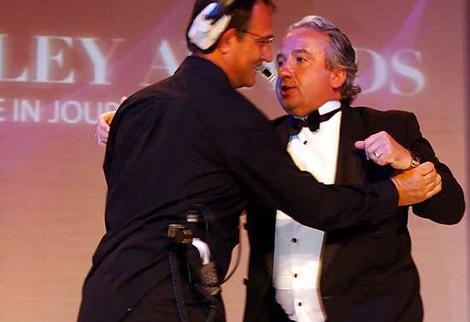
No doubt, the relationship between the so-called New Media and Old Media has gone through some, well, ups and downs. Below you can watch one of the low points: a clash between a grey-haired newspaper columnist and a sprightly 'shockblog' founder.

The ABC News site reports that on 30 November 2006, Glenn Milne, who writes for the Sunday Herald Sun, Sunday Telegraph and The Australian, had to be restrained and escorted from the stage of Melbourne's Crown Casino Palladium Ballroom, after he attacked and berated another journalist during what the Australians consider their most prestigious journalism awards.(Thanks to Geert Lovink for the pointer).

Not all Old-New media relationships are made in hell (or Australia). For a discussion on cases and issues, join the 5th Journalism Leaders Forum at the University of Central Lancashire in Preston or online on February 6th 2007.

Details about the open event and how you can participate in person or online, see the Forum blog.

Monday, November 06, 2006

From Editors' conference in Glasgow: The future of newspapers is already here

Roy Greenslade isn't given to flattery. But his post on the second session at the Society of Editors' conference in Glasgow this morning gushed with praise:
Rarely has a Society of Editors conference over the years hosted a session in which so many of the contributions were so stimulating and so genuinely informative. The speakers offered both practical guidance based on their own experiences along with some pointers to where we should be going.

Speakers included Simon Reynolds, editor of the Lancashire Evening Post in Preston, who's move to digital was supported in large part by a team from the department of journalism at the University of Central Lancashire. For a summary of the session is available on Gleenslade's GuardianUnlimited blog.

Thursday, September 14, 2006

Notes: a discussion on the quality of journalism

Organisational arrangements aside - the other panelists arrived late and the chair left early - the panel discussion on the Quality of Journalism at this year's Highway Africa conference was, well, a bit thin. Here are the comments I prepared:

Last week, Wired News published a story about wiki collaboration software which had been edited using, what else?, a wiki.

It started when the writer, Ryan Singel, filed a 1,059-word article. Rather than having his editor trim and shape it, they posted the story online on August 29th and challenged their users to edit it.

Singel even posted interview notes and conducted additional research in response to questions raised by the community.

Over the following week, the story went through more than 300 drafts, doubling in size as one reader conducted her own interview and added quotes, wiki vendors added references to their offerings and others contributed additional examples to support the premise.

Singel said the experiment has gone smoothly, devoid of the pranks and vandalism he had feared when Wired opened up the story to changes. With wikis, anyone may change, add or even delete passages, regardless of expertise.

Wired editors released the final version on Thursday [Sept 7th] after editors vetted the story for style and glaring errors.

Of course, though news organizations have tried collaborative articles before, [Esquire magazine ran a similar experiment on a story about the open encyclopedia Wikipedia. The Los Angeles Times also briefly opened its editorials to public editing, but suspended it after being flooded with bad language and even some porn.]

I think that this experiment flags some interesting questions for us as we contemplate the theme of this afternoon’s session: Quality in Journalism.

No, I don’t want to re-hash the debate about “Who is a journalist?’’ Instead, I want to think out loud with you about what the Internet revolution means for the quality of journalism?

You think calling it a ‘Revolution’ is overstating it? After all, Africans know a thing or two about revolutions.

Revolution, according to the Wikipedia (yes, there’s a theme here today):

Revolution is a drastic change that usually occurs relatively quickly. The word
revolution means "a turn around." This may be a change in the social or political institutions over a relatively short period of time, or a major change in its culture or economy. Some revolutions are led by the majority of the populace of a nation, others by a small band of revolutionaries, a so-called palace revolution only touches the ruling elite. Compare rebellion.

So, even if you agree that the advent of the Internet is bringing about a revolution in the mass media, we need to dig a little deeper to figure out: What is the precise nature of this revolution?

What is being “turned around”?

Well, a month past his 75th birthday, the courtly-mannered Australian-born American with the US $60 billion global media empire, Rupert Murdoch, gave Wired writers his take on the matter:

To find something comparable, you have to go back 500 years to the printing press, the birth of mass media – which, incidentally, is what really destroyed the old world of kings and aristocracies. Technology is shifting power away from the editors, the publishers, the establishment, the media elite. Now it’s thepeople who are taking control.

The people’s revolution? Doesn’t that sound familiar? Doesn’t that sound like, well, democracy?

But what does it mean to have a democratic media?
Does it mean that information is free and the audiences vote in the marketplace?
And, you might say, that may not be happening everywhere, but that idea could hardly be considered a 21st century revolution?

No, what Murdoch is referring to is the fundamental shift in the relationship between the professional media establishment and the media users.

THE OLD QUESTION: Where will the quality journalism come from?

REALLY ASKING: Do we really trust other citizens with journalism?

Of course, citizens have been questioning the bases for their trust in us – and, in many instances, they’ve come up empty handed – and moved off.

PERHAPS WE SHOULD ASK: How will a generation of talented storytellers use multiple Channels to engage in meaningful relationships with citizens so that they will trust us enough to work with us to create and share stories that are relevant?

What is conversation?
What is trust?

Trust, according to scholars such as Grunnig, Ledingham et al, can be defined as the level of confidence that both parties have in each other and their willingness to open themselves to the other party.

To me that sounds a lot like we’re talking about sharing, transparency?

And we need to take a candid look at the other elements of trust:

Dependability: the belief that an organisation will do what it says it will do.

What is it we as journalists say we will do? What is the ideology that unites this tribe across geographic and other borders?

Mark Deuze notes that the key elements of this ideology have been described by researchers (Golding and Elliott, 1979; Merritt, 1995; Kovach and Rosensthiel, 2001) as:

  • public service (watchdogs, news hounds, etc.)
  • objectivity (impartial, neutral, fair and, therefore, credible)
  • autonomy (free, independent);
  • immediacy (sense of actuality, speed inherent in the concept of ‘news’)
  • ethics (responsibility, validity, legitimacy).

I don’t need to dwell on how far we’ve fallen and how often we’ve failed. And, much like the Bafana Bafana and Springbok supporters, our users are fickle, remembering our defeats more vividly than our triumphs (except perhaps when we win the big ones).

The extent and the limits of what we say we can do and attempt to deliver needs to be open.

Integrity: the belief that an organisation is fair and just.

Deuze (2005) notes that considerations of objectivity and ethics as central elements of the ideology of journalism. These relate closely to the notion of integrity, a central element of trust.

To validate our claims of integrity, and so keep the public trust, we journalists have constructed professional codes of ethics and pursued objectivity. But this broad offering of trust by the public has pre-empted the practice of transparency by the journalist. Professional journalists have neither disclosed their sources or their methods as they have exercised their responsibility as trusted information providers to the public sphere.

Citizen publishers such as bloggers also value integrity; but they establish it from the opposite premise. Unencumbered by the requirements of the professional ideology, they tend to be transparent about their allegiances and perspective; and they urge their readers to seek other viewpoints.

As the public’s choice of information sources grows, the validity of this transparency-based model for establishing integrity is likely to increase, at the expense of the existing trust model that the professional seeks to work within. Trust is a critical element in relationships. Most scholars consider this dimension instrumental in an effective and mutually beneficial relationship. Journalists in the future may need to demonstrate increasing transparency, for example through linking to source documents or to transcripts of their interviews, if they are to maintain the public’s trust.

Competence: the belief that an organisation has the ability to do what it says it will do.

Much of twentieth century journalism was based on the premise that journalists needed ‘to know a little about a lot.’ Entrusted by citizens to be their window on the world, many journalists needed to turn their hand to any editorial area, be it news, foreign affairs, politics, economics, social issues, arts and culture, or other fields such as sport. Such versatility was applauded and seen as a mark of a journalist’s professionalism. It also became an increasing necessity as the number of correspondents and specialists was reduced.

Increasingly this professional requirement for journalists to spread their knowledge base thinly compares unfavourably with the range of information offered by the many citizen publishers who have a specific subject expertise or community knowledge (geographic or interest-based) that the journalist cannot match. As Gillmor states, “Journalists cannot hope to reflect the world as well as the world itself” (2006).

In time this is likely to erode trust based on the ‘know everything’ notion of a journalist’s competence.

They don’t necessarily need to know everything – or can’t – but they must have the capability – the ability and the willingness – to engage and build relationships with users.

How do we establish and maintains relationships. Through communication. Principally, convesation. And what is conversation?
Conversation is not me talking a lot. Conversation is not even me making eloquent and entertaining speeches.

Conversation is a two-way street. It’s dialogue. It means listening as least as much as you speak. Are we as journalists capable of that?

What is capability? Ability + Willingness. You can know how to ski, but that doesn’t mean you’ve got the gutzpa, the guts to tackle the high slopes.

For this new conversation we need to have the ability sure – the digital media tools and the skills to use them. We need to learn the digital language, if you will, and continue to develop our vocabulary. But we must also be willing to apply these new communication skills by meeting and engage with people in their space, on their terms. To treat them as equals – not haughtily, not aggressively, not simply as means to your economic or professional ends.

I don’t think that we need to belabour this point, but those organisations that don’t make significant investment in education and training part of their business plan, are likely to be in trouble.

So, to get back to the original theme for this discussion:

the quality of professional journalism in a digital age will depend on how effective we are at using technology as conversational tools to establish, build and maintain relationships with our users.

Oh, yes, Murdoch knows that, too.

That’s why he invested $580million in MySpace. To a meeting of the American Society of Editors in April 2005, he put it this way:

I come to this discussion not as an expert with all the answers, but as someone searching for answers to an emerging medium that is not my native language. Like many of you in this room, I’m a digital immigrant. I wasn’t weaned on the web, nor coddled on a computer. Instead, I grew up in a highly centralized world where news and information were tightly controlled by a few editors, who deemed to tell us what we could and should know. My two young daughters, on the other hand, will be digital natives. They’ll never know a world without ubiquitous broadband internet access.

The peculiar challenge then, is for us digital immigrants – many of whom are in positions to determine how news is assembled and disseminated -- to apply a digital
mindset to a new set of challenges. We need to realize that the next generation of people accessing news and information, whether from newspapers or any other source, have a different set of expectations about the kind of news they will get, including when and how they will get it, where they will get it from, and who they will get it from.

And what is the biggest threat to the quality of mainstream journalism?
It’s the leadership. Leadership - and many of their minions - who won’t share power with citizens. Leaders of journalism who – 12 years after the advent of democracy in South Africa and 12 years after the first newspapers were put online (including SA’s Mail &Guardian) – aren’t aware of the revolution or, if they are, still hope that the it will pass them by.

I’ll leave it there. I look forward to hearing your views.

Wednesday, January 25, 2006

Gillmor: Citizen journalism needs citizen audiences

Dan Gillmor, author of We the media, today announced the failure of his much-discussed citizen journalism venture, Bayosphere. His open letter on the lessons learned makes for fascinating reading. (I'm sure that folks at South Africa's pioneering citizen journalism venture, reporters.co.za, will be paying close attention. )

Next week (31/01/2006), Dan will joins others, including BBC Interactive's Pete Clifton, on the panel of the next Journalism Leaders Forum to discuss the impact of citizen journalism on the establishment - organisations, practitioners and the academy. The event, which is part of the residential week programme for the Journalism Leaders Programme at the University of Central Lancashire, will be Webcast live and it open to all.

Wednesday, September 07, 2005

Is it time for us to come clean about what we really do?

I wonder if it isn't time that we come clean and admit that the purpose of journalism isn't actually to give 'a voice to the voiceless'? That it isn't about 'keeping the powerful ccountable'? That publishers and editors don't set out to every day to serve their communities? That, instead, when all is said and done, journalism is simply about creating wealth.

That, at least, would seem to be a reasonable conclusion if Pelle Anderson is to be believed. Jonah Bloom, executive editor of Advertising Age, recently asked Anderson and three other designers to rethink how the New York Times ('the Grey Lady') coulld adapt to "the new consumer realities of the 21st century." Anderson made this point:

The core business idea of any newspaper (although the publishers and editors tend to avoid admitting to this) is to deliver a number of readers to the advertisers, or, more precisely, a certain exposure of the ads to a specific audience. The time the readers spend with the papers is the currency the newspapers sell to advertisers, and that time has been steadily diminishing since the '60s. What to do? To just go on producing what to a large extent is an increasingly irrelevant newspaper, like the New York Times does, is not a good idea.

The laws of the market apply to the New York Times as well, and species that don’t adapt will eventually perish. The future is coming, and it's coming fast.


If Anderson is right, then perhaps it could be argued that if those quaint notions about the public purpose of journalism have any use at all, it would be to keep pesky legislators at bay and to allow us to insist that (for the most part) we deserve free access to the raw materials of our enterprise (information)? Perhaps, too, the so-called 'Chinese Wall' that once divided newsrooms and their their public-service ambitions from advertising departments with their profit motives was simply a useful construct by owners and bonus-driven managers to keep a steady flow of talented idealists working long hours for low wages?

Or am I missing something?

Friday, August 26, 2005

Making media matches

The World Editors Forum weblog reports that a recent survey has shown that almost every second American television station has a tie-in with a newspaper, which got me in the matchmaking mood.

My fist choice for a South African media match would be the SABC and Daily Sun. Why? Well, both Dr Snuki Zikala of the SABC and Dion du Plessis of the Daily Voice seem to be taking their journalistic mandate of "giving a voice to the voiceless" seriously. Du Plessis says the Daily Sun gives a platform to people you've probably never heard of (citizens), while the SABC has been under fire for being a mouthpiece of those to whom you seldom want to listen (government officials). I'm sure the two giants of the local media market will be able to find lots of ways to share resources.

Any suggestions for other media matches?

Thursday, August 11, 2005

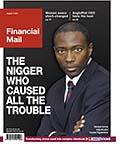
The (other) N***** who caused all the trouble

Financial Mail editor Barney Mthombothi says the coverline of the August 7 edition was just a bit of fun (see left). "It was meant to be tongue-in-cheek," he says, "and provocative, but never to offend." But offend, he did. The phone rang off the hook, he says in his latest "Editor's Note". The mailbox was flooded with letters. "Some of the callers were apoplectic with anger."

Mbthombothi must be relieved that Constitutional Court Judge Albie Sachs ruled on 27 May 2005 that South Africans have a constitutional right to laugh. (Case CCT 42/07 was about the squabble between Laugh It Off Inc and SAB, who didn't think the 'Black Labour, White Guilt' T-shirt was a laughing matter at all. For more background see: http://www.laughitoff.co.za/legal/legal.htm ) .

Paragraph 107 of Sachs' judgement is particularly relevant:

...The Constitution cannot oblige the dour to laugh. It can, however,
prevent the cheerless from snuffing out the laughter of the blithe spirits
among us.
Indeed, if our society became completely solemn because of the
exercise of state power at the behest of the worthy, not only would all
irrelevant laughter be suppressed, but temperance considerations could end
up placing beer-drinking itself in jeopardy. And I can see no reason in
principle why a joke against the government can be tolerated, but one at the
expense of what used to be called Big Business, cannot
[emphasis added].

So, yes, Mthombothi has a Constitution right to kid around a bit. But did his joke make for good journalism?

Tuesday, August 02, 2005

TIP: A really simply way to keep up with the news

The other day I was asked, once again: "How do you keep up with the latest news from around the world?"
The answer: RSS or Really Simple Syndication software which automatically pushes the latest news from a variety of my preferred news sources directly to my desktop. Of course, the sites must be appropriately enabled. I use SharpReader v0.9.5.1, but there are many other free programmes available for download here.

These are on my list right now:

SA news - Independent Online & Mail&Guardian Online

UK news - The FT (recently named the best paper in the world), the Guardian and, of course, BBC Online

US news - the New York Times and Time magazine

Other news - I also follow a number of blogs to keep up with news and gossip in the journalism industry and a couple others besides.

Those I'd like to subscribe to - but can't because they don't allow RSS feeds - include: News24 and TheMedia .

Got any suggestions for other sites to keep tabs on?

Friday, July 29, 2005

Page 3 girls and other questions about tabloids

The phenomenal rise of South Africa's tabloids has got tongues wagging within the country's borders - and beyond. For a summary, see this recent post on World Editors Forum weblog.

Perhaps we should build up a reference list of research on tabloids? What about a list of tips on how trainers can better prepare would-be journalists for positions in this fast-growing segment of the industry?

Wednesday, July 27, 2005

Want to know your EQ?

There weren’t many options when we got to Groovy Movies & Take-Aways in the West Coast village of St Helena Bay on Sunday. So, after negotiating with my partner, we settled on “Spiderman 2”. It gave me another chance to watch my new favorite movie newspaper editor, J.K. Simmons as the cigar-chomping Daily Bugle boss J. Jonah Jameson. He's a crass, cynical sensation monger and he doesn't care who knows it. Like everything else in "Spiderman," he's a homage to the prototype.

Stricter labour laws and union watchdogs have probably cut down the numbers of those who follow the “J. Jonah Jameson Approach to Editorial Management”. Not too many editors working today can get away with shouting, "You're fired!" Still, anecdotal evidence suggests that more than a few newsroom managers (and others) could use some help with developing their Emotional Intelligence (EI) quotients.

The first step, of course, would be to know where one stands. One's EQ, if you will. Well, here’s a chance. A colleague of mine is looking for participants for research into (EI). The research is all online and involves completing a number of questionnaires.

Taking part has several benefits. It’ll give you a chance to actually experience some of the standardized measures of EI that are used for both research and assessment, and for developmental (i.e., educational or occupational) purposes. Those who take part in the research will also get an assessment of their emotional intelligence, happiness and satisfaction with life, as well as interpretations of these scores.


If you want more information, contact of Kathryn Gardner, at the University of Central Lancashire's Department of Psychology.

Thursday, July 21, 2005

Just what we need

Such a forum is just what we need. Well done Francois for starting one.

hi

Hi Francois and all
Just to let you know I also joined the blog - looking forward to following the debates here.
Best,
Herman Wasserman

Thursday, July 14, 2005

Some gossip about Gilbert

A little hearsay from the South African National Editors Forum (Sanef) Annual General Meeting this week: '... a more committed journalism trainer you couldn't wish to meet.'
And who was being gossiped about? Gilbert Mokwatedi of Tshwane University of Technology.

Now, I've never actually met Gilbert, but the Oxford University Press editors knew that he had been using an earlier version of Writing for the Media and got him to write something nice about the latest edition for the back cover. Unfortunately, they could only use a few sentences of it, so I thought I might be a good idea to publish the whole piece here.

Over to you, Gilbert:

The world is changing and the media can't be left behind. For the media, the change is visible with regard to technology, culture and the treatment of information itself. Journalists should accommodate new thinking. What worked 10 years ago might not work today.
Walker Lundy, an editor and executive vice president of the Philadelphia Inquirer summed it up with these words: "If you are not in a newsroom that's trying to change, you should be worried".
Education and training are some of the forums and mechanisms enabling journalists to meet the tide and pace of changes.
François Nel's third edition of Writing for the Media comes at the right time when media and non-media practitioners are complaining about the state of journalism in the country and looking for solutions. Computer Assisted Reporting and Information and Communication Technology (ICT) are some of the buzzwords in the media industry. The book comes in handy as it includes a list of available resources relevant to each chapter and also covers new developments in information technology.


PS. The Pew Centre's comprehensive 'State of the Media' report details some of the changes in the US media. Wouldn't it be a good idea to roll out comparative reports elsewhere around the world? Anyone keen?

Friday, July 08, 2005

Mind the media

Starting this blog on a Friday afternoon in July doesn't really seem logical. Then again, that might just be appropriate. After all, if Mail & Guardian columnist Tom Eaton is to be believed, "the media has no mind, only a nervous system, and any direction it goes in is merely a reaction and not the results of a decision.” The media, Eaton suggestions, scurries around like little worker ants scrapping up specks of nourishment to feed the insatiable blob of idle consumption: “the royal reader, the queenly subscriber, whose every whim must be pandered to, whose interest must be sustained…” Well, despite what Eaton may think, there is indeed a smidgeon of intention, of actual rationale, in the inception of this blog. It is to be a space for people who care to talk critically about the media, in general, and exchange ideas about how to ensure the news media keep on, and keep on getting better. Perhaps starting that conversation on the day after bombs ripped apart lives along with parts of the London public transport system - and those who can and care are glued to the media for updates – has some kind of logic after all.